
Governance · November 16, 2026
The Top of the Lifecycle: Certifiable, Optimized, and Whether You Need Either
By David Monahan · Data Defenders, LLC · the last two stages, the plateau most programs stop on, and the honest answer about aiming higher
The honest thing to say about the last two stages of the AI Governance Lifecycle is that most organizations should not be aiming at them. Not this year, and some not ever. Advice about the top of any maturity model tends to turn aspirational exactly where it should get specific — everyone is told to climb, nobody is told what the climb costs or who it is actually for. This post closes the series with what Certifiable and Optimized require, where almost every program stalls on the way, and the test that tells you whether either is your next move.
Certifiable is not "we would pass"
The intuitive definition treats certification as a test with an answer key — you either meet the control or you don't. That is not how control documentation works. Controls are written in general language and read by people, and two qualified auditors can read the same clause differently and both be defensible. There is no fact of the matter sitting underneath waiting to be discovered.
What that leaves you is the part you actually govern. A Certifiable program can assemble a coherent proposal: evidence mapped to each control under a stated interpretation of what that control requires, with the reasoning attached and defensible when questioned. You present that proposal. The auditor decides whether your reading matches theirs.
This is a meaningful distinction and not a semantic one. Nobody — no consultant, no platform, no internal team — can promise a compliance-ready package, because acceptance is not theirs to give. What can be built is a defensible one. The previous post drew the line at Managed: a Managed program can produce the evidence. A Certifiable program can produce the argument.
In practice the gap between those two is narrower than it sounds and harder than it looks. Most programs that map artifacts to controls never record why they read the control that way. The mapping exists; the interpretation behind it lives in someone's head. When the auditor's reading differs — and on some control it will — there is no stated position to defend, only a silence that looks like the mapping was arbitrary.
ISO/IEC 42001 gates certification on clauses that evidence-rich programs routinely fail, and they are not the documentation clauses. Clause 9.2 requires an internal audit program running on its own schedule. Clause 9.3 requires management review. Clause 10.2 requires that when a nonconformity occurs the organization contains it, analyzes root cause, checks whether similar issues exist elsewhere, carries out corrective action, verifies that the action actually stopped recurrence, and keeps documented information on all of it. A program that finds problems and cannot show it closed them has artifacts. It does not yet have a system.
The uncomfortable implication is worth stating plainly: you can do all of this correctly and still take a finding, because interpretation varies. That is not a failure of the program. It is the nature of the thing, and a program that understands that goes into the room prepared to make a case rather than expecting to be graded.
Optimized is automation — but automation comes last
Optimized is about the organization's own processes, not the auditor's. A program with every control in place and entirely manual monitoring, collection, packaging, and delivery is Managed and nothing more. It may be a good program. It is not an optimized one.
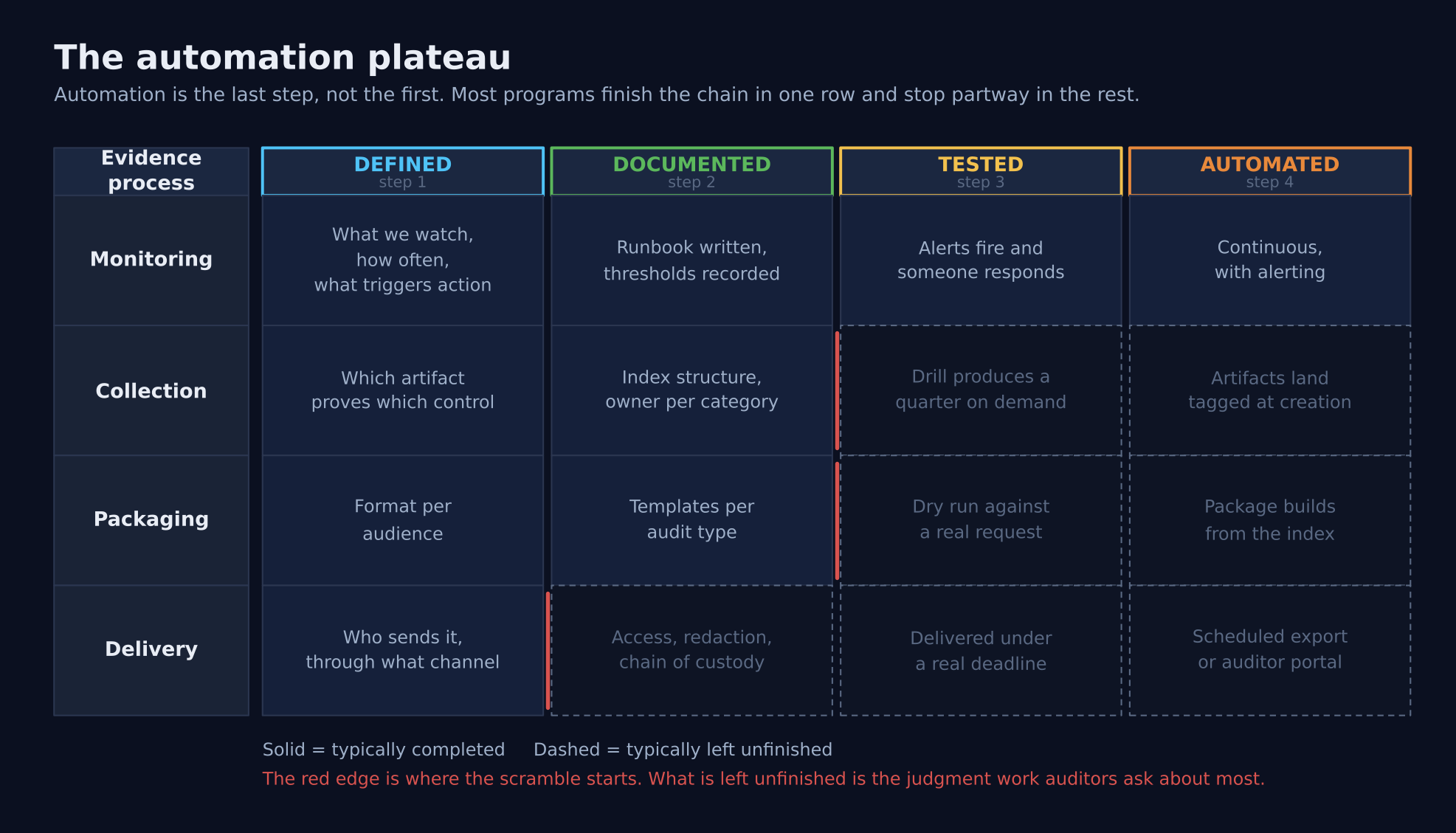
Automation is the stage's mechanism, and it is the fourth step of four, not the first:
- Defined. The organization has decided how this gets done — what gets watched, what gets collected, who assembles it, how it goes out.
- Documented. Written down well enough that a different person runs it the same way. This is the step that survives turnover.
- Tested. Actually run, under realistic conditions, and shown to hold. The annual production drill from the previous post is this step: pick a quarter at random and produce the package against a deadline.
- Automated. The machine does it. Now, and only now.
Skip the first three and automation produces the wrong output faster, with fewer people who understand the mechanism well enough to notice. This is the same mistake the Governed post identified as the third trap keeping organizations below Governed — buying governance tools before writing the policy, on the theory that the tool will supply the decision. Tools automate decisions already made; they do not substitute for them. At the bottom of the lifecycle that error keeps you out of Governed. At the top it produces an expensive imitation of Optimized. Same mistake, higher price.
The plateau almost everyone stops on
In practice organizations do not land cleanly on either side of the automation line. They land in a mix — some processes carried all the way through, others abandoned partway — and then they stay there. When an auditor shows up, the automated parts answer themselves and the rest gets assembled by hand under deadline. The scramble works, more or less, every time. Which is precisely why the remaining work never gets finished: nothing ever breaks badly enough to force it.
Click the chart to open it full size.
Which parts get finished is predictable, and it is backwards. Automation goes where it is easiest: log retention, access review exports, inventory synchronization — high-volume mechanical work with clean inputs. What stays manual is the judgment work: the reasoning behind a risk score, approval records scattered across three systems, vendor reassessment after a model update, the narrative of what happened during an incident.
So the half that runs itself is the half nobody asks hard questions about, and the half assembled by hand the night before is exactly what an auditor drills into. The automation most organizations have bought proves the least.
This series opened by naming a gap — the one spanning Investigation, Experimentation, and Sanctioned, where roughly three-quarters of organizations sit below Governed. The plateau is the other gap, at the opposite end, and it is quieter. Nobody is alarmed about it, because every program sitting on it can point to real automation and real evidence. It just cannot produce either without a scramble.
Should you be aiming here?
Certifiable is worth reaching when someone is actually going to ask. That means EU AI Act exposure on a high-risk system, enterprise customers whose procurement process demands evidence of an AI management system, a regulated sector where the examiner is a matter of when rather than if, or a cyber carrier that has started asking AI questions at renewal. If nobody in your market is going to request a certification-grade proposal in the next two years, building one is expensive preparation for a conversation that will not happen.
Optimized is a function of volume, not ambition. Four AI systems and one annual review cycle do not justify an automation program — the automation costs more than the manual work it replaces, and it adds a system that itself needs governing. Forty systems with continuous obligations across several jurisdictions is a different problem, and at that scale manual collection stops being inefficient and starts being unreliable.
There is a test that settles it without much debate. Take any one of your evidence processes and ask how far down the chain it actually goes. If it is not defined, documented, and drilled, automation is not your next move regardless of what you can afford to spend. Finish the chain on one process before starting another — a single process carried all the way through is worth more than four stalled at step two, and it is the only version of this work that reduces the scramble rather than relocating it.
Not sure which stage describes your program today?
Pick the framework that fits your situation and take a free 15-question snapshot. On-screen results with no signup, or choose the optional PDF to take away.
See the snapshots →What the seven stages add up to
Across this series one line has run through every stage, and it is not about intent. Governed means the controls exist. Managed means you can prove they ran. Certifiable means you can defend your reading of them. Optimized means the proof assembles itself. Every step up the lifecycle is a step from what an organization means to do toward what it can demonstrate it did — and the demonstration is the only part anyone outside the building can see.
That is also why the stages cannot be skipped. Evidence you cannot produce is indistinguishable from governance you never had. An interpretation you never recorded is indistinguishable from a mapping you made up. Automation on top of an undefined process is indistinguishable from no process at all, except that it is faster and harder to inspect. At every level the failure looks the same from outside: a program that may well be working, with nothing to show for it.
Most organizations reading this belong at Governed or Managed, and getting there properly is worth more than a partial run at anything above it. The top of the lifecycle is not a destination every program should reach. It is where a specific kind of organization — enough systems, enough exposure, enough people asking — eventually has to live.
Build it yourself — or use ours
Everything across this series is enough to build and advance an AI governance program in-house. If you would rather start by finding out which stage actually describes you today, that is what our AI Maturity Assessments are for.
Every control is scored against the seven risk dimensions, anchored to NIST AI RMF and ISO/IEC 42001, with each finding carrying a remediation recommendation tied to benchmark research. The free Snapshot gives the directional read in 15 questions; the full Assessment produces the findings.
And when the audit is already on the calendar, our Audit Support engagements work the evidence side directly: a prioritized gap register with owners and target dates, evidence templates matched to your framework, and someone in the room during fieldwork.
See the snapshots →Sources: ISO/IEC 42001:2023, clause 9.2 (internal audit), clause 9.3 (management review), clause 10.1 (continual improvement), and clause 10.2 (nonconformity and corrective action — containment, root cause analysis, verification that corrective action prevented recurrence, and documented information on each); EU AI Act (Regulation 2024/1689), Article 12 (record-keeping and automatic log generation for high-risk AI systems) and Article 19 (log retention for a period appropriate to the intended purpose, of at least six months unless otherwise provided by Union or national law); NIST AI RMF 1.0 (AI 100-1), GOVERN and MANAGE functions.
Talk to Us Directly
Free 25-minute consultation. Bring your questions.